The most useful thing about a new AI model is rarely the benchmark chart. It is what the release changes about the work you can hand over without wasting time, money or attention.
OpenAI released GPT-6 Sol and GPT-6 Luna as faster, lower-cost members of the GPT-6 family. The practical question is not which model is “best.” It is whether the task in front of you actually needs more capability.
Start with the lightest model that can do the job reliably. Move up when the task becomes ambiguous, multi-step, high-consequence or difficult to verify.
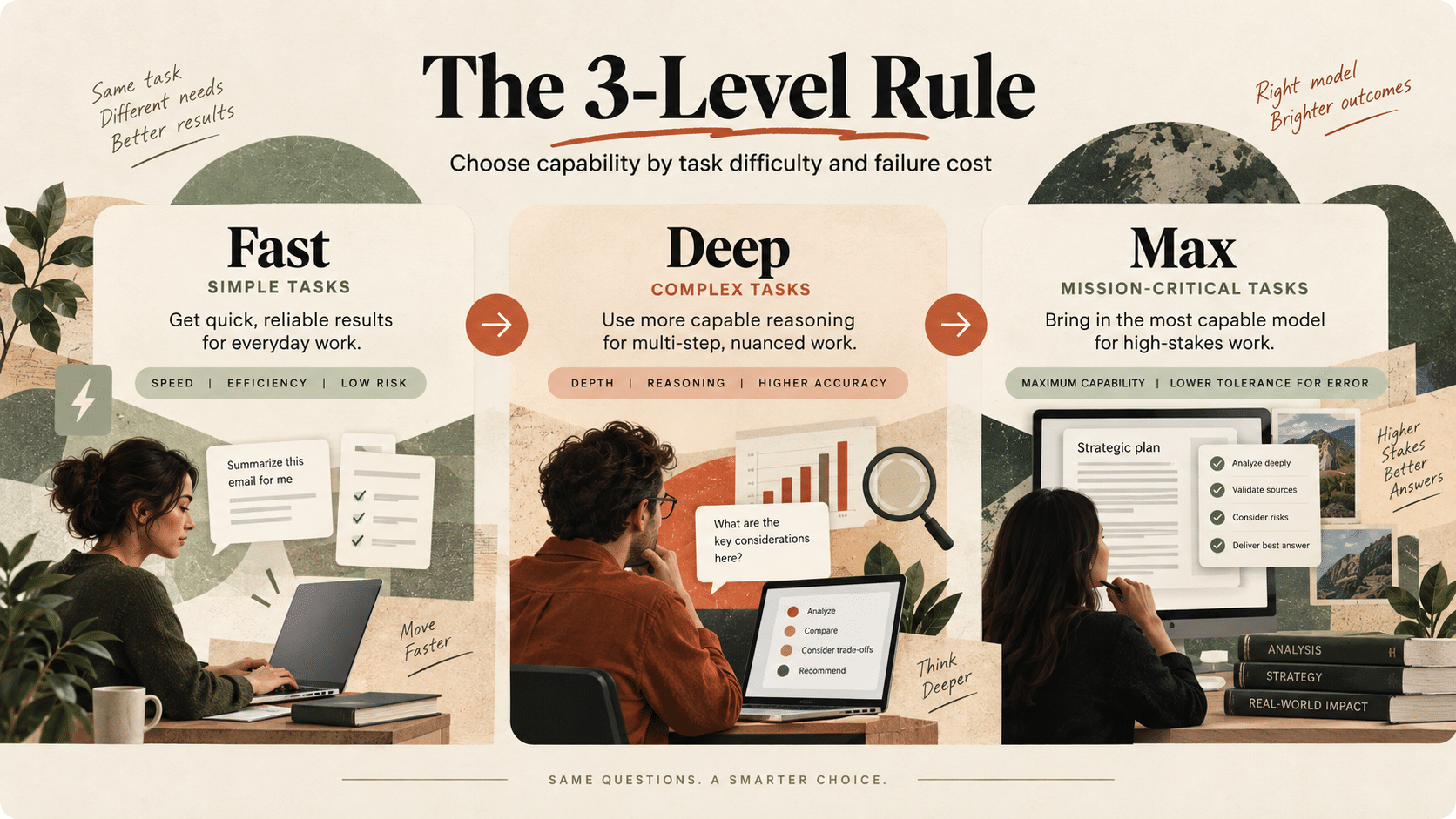
Use a three-level rule
FAST clear, repetitive work that is easy to check rewriting, extraction, classification, formatting and straightforward summaries.
DEEP work that requires connecting information, handling ambiguity, comparing trade-offs, analysing data or completing several dependent steps.
MAX genuinely difficult or high-consequence work where a weak answer may be hard to spot. More capability still does not replace human review.
Choose by failure cost
A five-minute rewrite, a messy spreadsheet analysis and a multi-step coding job should not automatically use the same model. Ask how difficult an error would be to notice and what happens if it survives review.
If a mediocre answer is obvious and cheap to fix, start light. If a subtle mistake could influence a decision, use more capability and tighten the checking process.
A 10-second model picker
Before starting, ask Is the task clear or ambiguous? Is it one step or many? Can I verify the answer quickly? Is the cost of a mistake low or high?
Clear + simple + easy to check usually belongs in FAST. Ambiguous + multi-step belongs in DEEP. Difficult + consequential + hard to verify belongs in MAX.
Classify this task as FAST, DEEP or MAX based on reasoning depth, ambiguity, verification difficulty and cost of error. Tell me the lightest suitable starting point, what a good result must include, and the exact failure condition that should make me move to a stronger model. Do not solve the task yet.
Test models on your own work
Benchmarks help narrow options. Your recurring tasks are a better final test. Keep the same input, success criteria and review checklist, then compare models on correction time rather than first impressions.
Useful tests include a meeting summary, a real spreadsheet analysis, a source-based research task, a piece of writing in your normal voice and one multi-step task that frequently fails.
Do not turn model switching into another ritual
Create defaults. Pick one fast model for routine work, one stronger model for analysis and one escalation option for genuinely difficult work. Change only when the task gives you a reason.
For teams, the same idea can become a routing rule. Repetitive extraction and formatting stay on the cheapest reliable model. Complex synthesis moves up. High-impact outputs require explicit review regardless of which model produced them.
Check availability before rebuilding a workflow
Model access can vary by plan, product surface and workspace settings. A release announcement does not mean every user sees the same model in the same place. Confirm what is actually available to you before changing a process around it.
Keep a tiny test set
Save three to five tasks you genuinely repeat, along with the inputs and a short review checklist. When a new model arrives, rerun those tasks before changing your defaults. Your own correction rate, completion time and confidence are more useful than a leaderboard built around work you never do.
The everyday rule
If you cannot explain why a task needs the expensive model, try the lighter one first. If you cannot explain how you will catch a bad answer, do not automate the decision.
Sources
OpenAI, Introducing GPT-6 Sol and Luna.