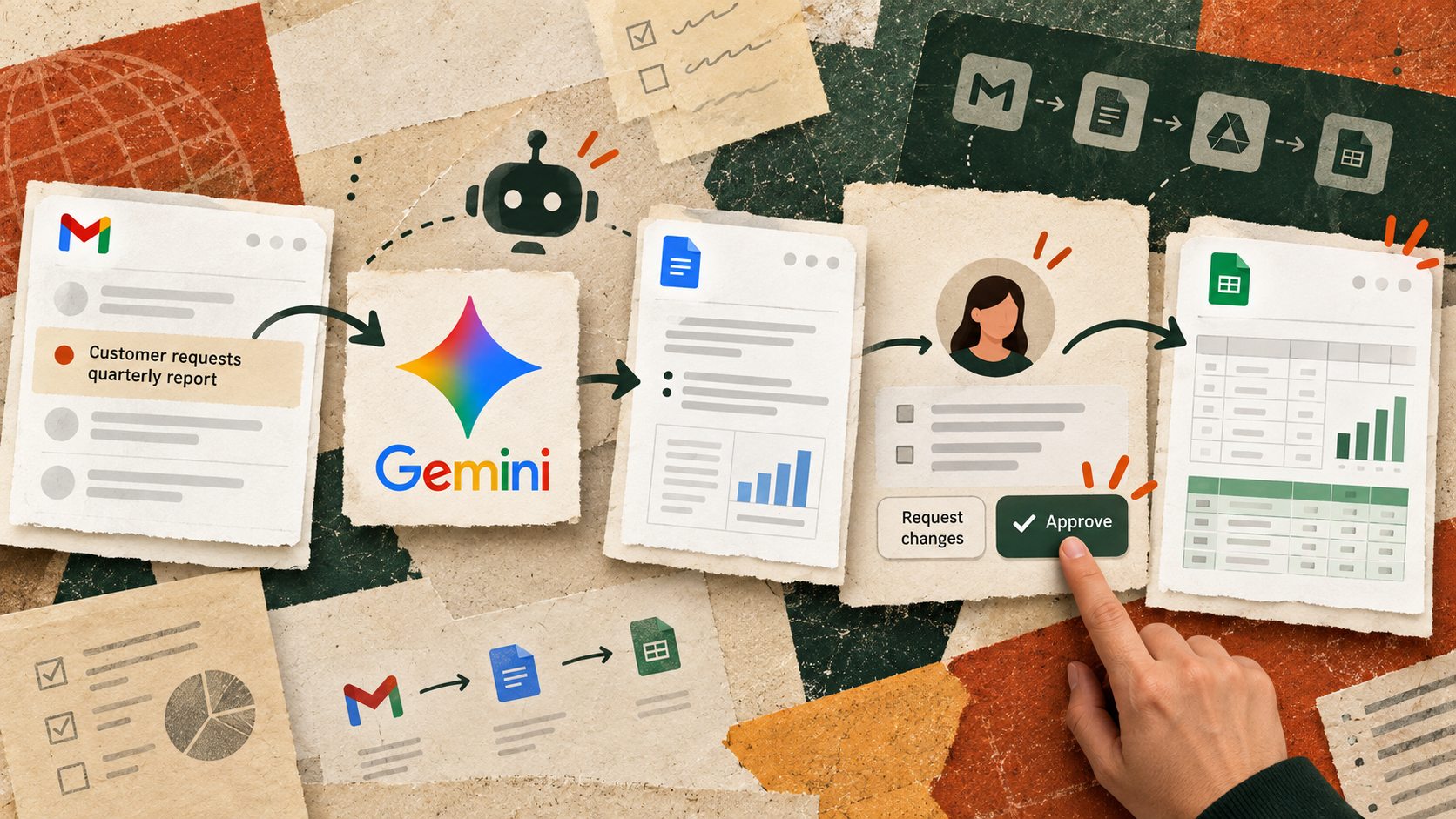
Google Cloud announced a new Gemini agent on October 8, 2026. The promise is not another chat box with better answers. Google says the agent can work across business systems, choose models for different tasks and return finished work in the apps people already use.
For someone managing projects, customers or a small team, the interesting question is much simpler. Can it move a task from one place to another without losing the decision, the deadline or the person responsible?
What Google announced and what it does not prove yet
Google describes the new Gemini agent as a single work assistant that connects to business tools, plans multi-step tasks and operates across environments including Google Workspace, Microsoft 365 and Slack. Google also says it can use Gemini and Claude models, with controls for cost and administration. Reuters reported the announcement on October 8.
Those are product capabilities described by the company, not proof that every employee can use every integration today. Access depends on an organisation’s setup, plan, administrator and rollout. Do not connect company systems or assume a feature is enabled without approval.
A useful work agent should preserve the handoff, not just produce a polished answer.
Start with a task that has a clear finish line
Imagine a project coordinator preparing for a weekly client review. The team has a meeting note, a list of open issues and a status tracker. The usual job is to identify the latest decisions, update the tracker and draft a short follow-up for approval.
This is a better test than asking an agent to manage the whole project. The inputs are known, the expected output is easy to inspect and nothing needs to be sent automatically.
Use fictional or approved non-sensitive data for the first test. For example, a meeting note says the website banner is approved, the pricing page still needs legal review and the client wants a revised timeline by Friday. The tracker still shows all three as pending.
Run the three-part handoff test
What a good result should contain
- Find the right evidence Identify the latest approved decision and the exact note or record supporting it.
- Make the proposed change visible Show which tracker rows would change, which stay open and which facts still need confirmation.
- Stop before an external action Draft the follow-up message for review rather than sending it, changing permissions or committing to a deadline.
The output should mark the banner as approved, keep the pricing page pending legal review and flag the Friday timeline as a request, not an agreed delivery date. If the agent invents an owner or treats a request as a commitment, the handoff failed even if the message reads well.
Try this now with an approved AI tool
If your organisation has access to the new Gemini agent and the necessary integrations are approved, test it on a copy of a small workflow. Otherwise, paste fictional notes and a fictional tracker into an AI chat approved for work. You can test the reasoning without granting access to live apps.
Copy-paste prompt for a controlled handoff
I need to turn meeting notes into a proposed project tracker update and a draft follow-up. Work only with the material I provide or the approved sources I name.
First list each decision, request, open question and deadline separately. For every item, identify the source note or exact passage. Do not treat a request as an approval. Do not invent an owner, date or status.
Next show a before-and-after table for the tracker with the reason for each proposed change. Mark anything unsupported as needs confirmation.
Finally draft a concise follow-up message, but do not send it or edit any live system. Ask me to approve each proposed change first.
Here are the meeting notes and tracker – [paste fictional or authorised information].
Verify before using Check the decision wording, owner, deadline and source for every proposed change. Confirm no message was sent and no live record was edited.
Use a simple pass or fail score
Check five things after the test. Did it use the newest relevant source? Did it preserve the difference between approved and requested work? Did it keep owners and dates accurate? Did it show exactly what would change? Did it wait for human approval before an external action?
Pass only when all five are correct. A partly correct answer is still useful as a draft, but it is not ready to run without supervision. Repeat with one contradictory note to see whether the tool asks for clarification instead of silently choosing.
Where the new announcement matters
Google’s broader direction is to make the agent a place where work moves across systems rather than stopping at an answer. That could reduce manual copying between notes, trackers and messages. It also makes provenance and approvals more important because a wrong assumption can travel farther.
For most working people, the first useful question is not which model the agent selected. It is whether the next person can tell what changed, why it changed and what still needs their decision.
Sources
Google Cloud – Gemini agent announcement – October 8, 2026
Google Cloud – Gemini for small and midsize businesses – October 8, 2026
Reuters – Google Cloud introduces Gemini agent – October 8, 2026