An AI assistant can suggest a cleaner way to run a recurring task in seconds. It might recommend moving weekly updates from email into a shared tracker, changing who approves a client brief or automating a reminder. The proposal sounds efficient until the new process misses an update and nobody remembers how the old one worked.
There is a simple habit worth borrowing from software teams. Before you make a change, decide how you would reverse it. You do not need to be an engineer to use that idea. A five-minute rollback check can make an ordinary workplace experiment less risky.
A useful AI plan explains how to stop, not just how to start.
Why the undo step belongs in the first draft
Change-management guidance from Atlassian includes a plan for expected outcomes, testing and ways to roll back a change. Google’s Site Reliability Engineering workbook describes testing software changes with a small group before a wider rollout. Those references concern managed technical changes, not evidence that every office process needs an IT-style approval board. The transferable idea is to make small changes observable and reversible.
AI makes it easy to generate an ambitious rollout checklist. It is less reliable at knowing your team’s unwritten dependencies. The assistant may not know that a client still expects the old email, that one colleague cannot access the tracker or that the weekly report feeds another team’s Monday meeting. Treat its plan as a draft to test with people who own the work.
Start with one reversible change
Choose a low-risk, repeatable process. Good candidates include an internal status update, a shared meeting agenda or the way a team collects non-sensitive review comments. Do not use this experiment for payroll, financial approvals, security permissions, customer data or any process with legal or compliance obligations unless the responsible owner explicitly approves a controlled test.
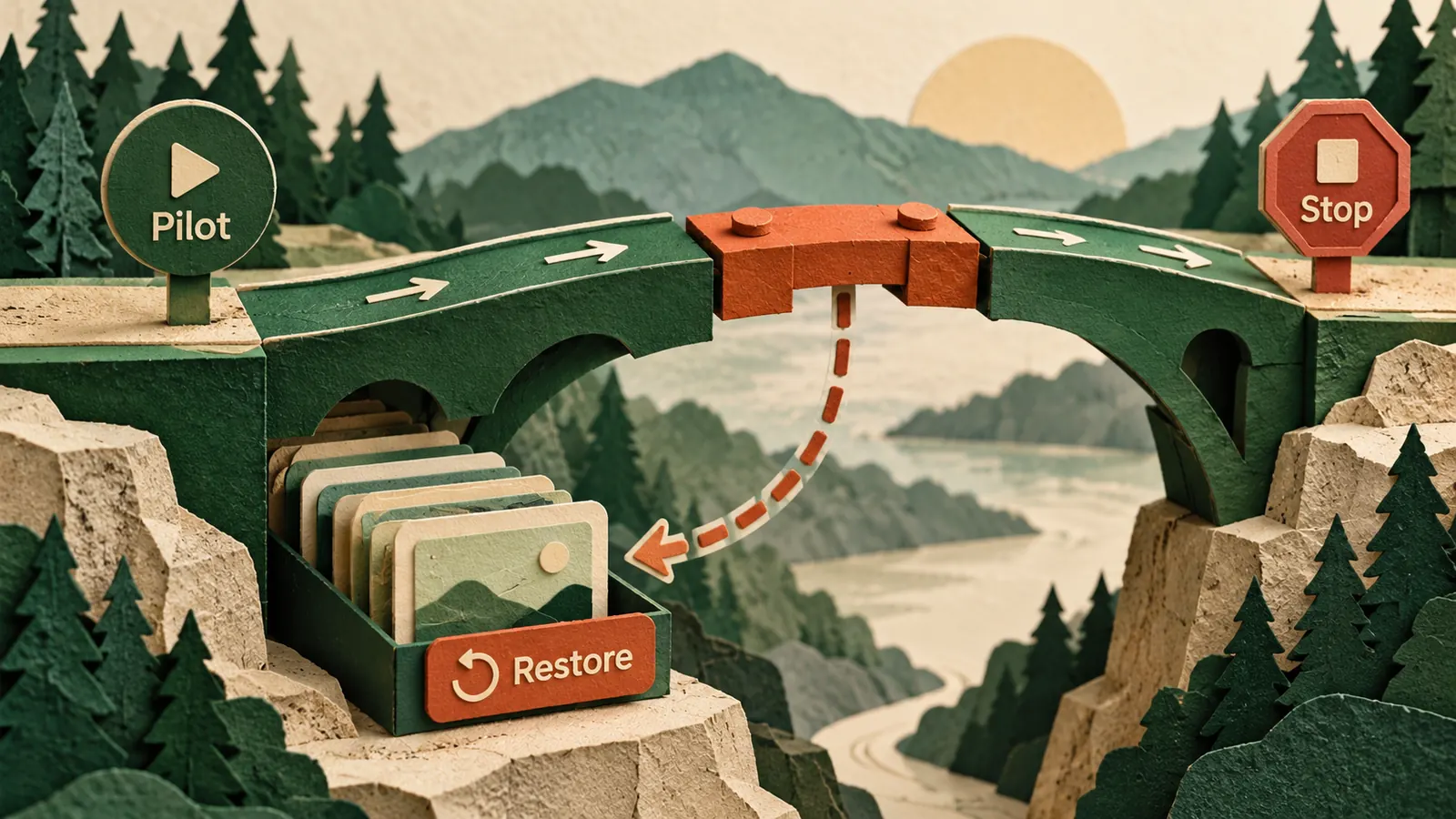
The five parts of a reversible plan
- Current state Record what happens today, who uses the output and where the original record lives.
- Small pilot Change one team, one report or one cycle instead of replacing the whole process at once.
- Success signal Name an observable outcome such as every required update arriving by the agreed deadline.
- Stop signal Decide in advance what failure would end the test, including missed work or an unexpected access problem.
- Return path Name the person who can restore the previous process, what they must preserve and when the team will be told.
Keep the original template and the last approved version available during the pilot. A backup that nobody can find is not a rollback plan. If a system change cannot be undone cleanly, stop and involve the appropriate administrator rather than asking AI to improvise recovery instructions.
See how this works in a normal team
Imagine an eight-person marketing team that emails its weekly project status to a manager every Friday. The team wants to switch to a shared tracker so updates are easier to review. This is a fictional example, not a measured productivity study.
The assistant proposes replacing email immediately. A better plan starts with two volunteers using the tracker for one Friday while the existing email continues. The manager checks whether both updates are complete, readable and available to the people who need them. The test owner records any missing fields or access issues. Nobody deletes the email template.
Suppose one volunteer cannot open the tracker from their approved account. That is a stop signal, not a reason to tell everyone to work around permissions. The owner continues with the email process, records the access issue and asks the system administrator to investigate. A wider switch happens only after the access test and the manager’s review pass.
The point is not to make every simple change bureaucratic. It is to avoid the expensive surprise of discovering that a smooth-looking AI plan removed a step someone depended on.
Copy this prompt before changing a process
Use an AI tool approved by your organisation. Describe the workflow with fictional or sanitised details first. Do not paste customer records, credentials, employee information or confidential documents into an unapproved assistant.
Reusable rollback planning prompt
Act as a cautious operations partner. Help me test one proposed change to a recurring workplace process without losing the ability to return to the current process.
The current process is [describe the steps, owner and output].
The proposed change is [describe one specific improvement].
The people affected are [roles, not private personal details].
The systems and approvals involved are [list approved tools and decision owners].
The information I am permitted to share with this AI tool is [state the boundary].
First ask up to five questions about missing dependencies, access, deadlines, recipients and approvals. Do not assume that any approval has been granted.
Then produce a one-cycle pilot plan showing the unchanged baseline, pilot group, expected benefit, two measurable success checks, two stop signals, a named human decision owner, exact rollback steps, records to preserve and a message to send if the pilot is stopped.
Mark unknown facts as Needs confirmation. Do not invent access rights, timings or capabilities. Recommend no automatic changes to live systems. Finish with a short checklist a human can verify before deciding whether to expand the pilot.
Run the prompt once, answer the missing questions and read the proposed return path before taking any action. If it says simply revert to the old way, ask it to spell out which template, location, owner and communication are involved. A plan that cannot name those details is unfinished.
Verify the rollback before you need it
Six checks before the pilot begins
- Confirm the previous process and its latest approved template still exist.
- Ask the people receiving the output whether the pilot format meets their needs.
- Check that every pilot participant has the required access without sharing passwords.
- Set a clear start, end and human review time.
- Write down what would make you stop, and who has authority to do so.
- Test the return message and the manual fallback using a harmless sample.
After one cycle, compare the new and old processes on completion, corrections, time spent and missed handoffs. Do not count a faster draft as a success if it creates extra work later. Keep the pilot small if the evidence is mixed. Stop it if a critical requirement fails.
The US National Institute of Standards and Technology offers a voluntary AI Risk Management Framework that emphasises evaluation and trustworthy use. For this everyday workflow, that means keeping humans responsible for decisions and checking AI suggestions against the real process rather than treating generated instructions as permission to act.
One reversible experiment is enough to learn something useful. Ask AI for the path forward, then insist on a credible path back.
Sources
Atlassian guidance on change planning, testing and rollback