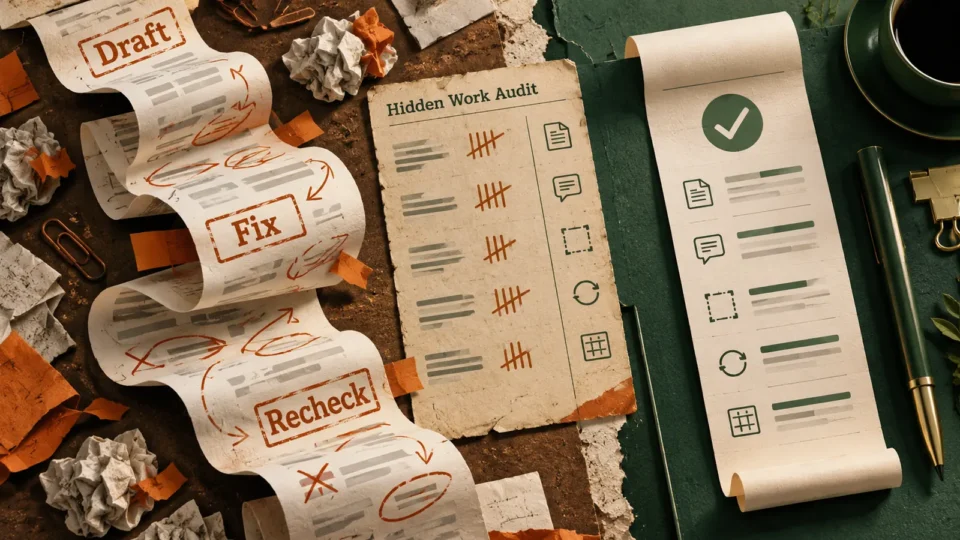
An AI assistant can turn a scattered year of work into a confident self-review in seconds. The problem is that confident wording can quietly turn participation into ownership, estimates into measured results and routine activity into claims you cannot defend. Use AI as an editor, not as a witness to your work.
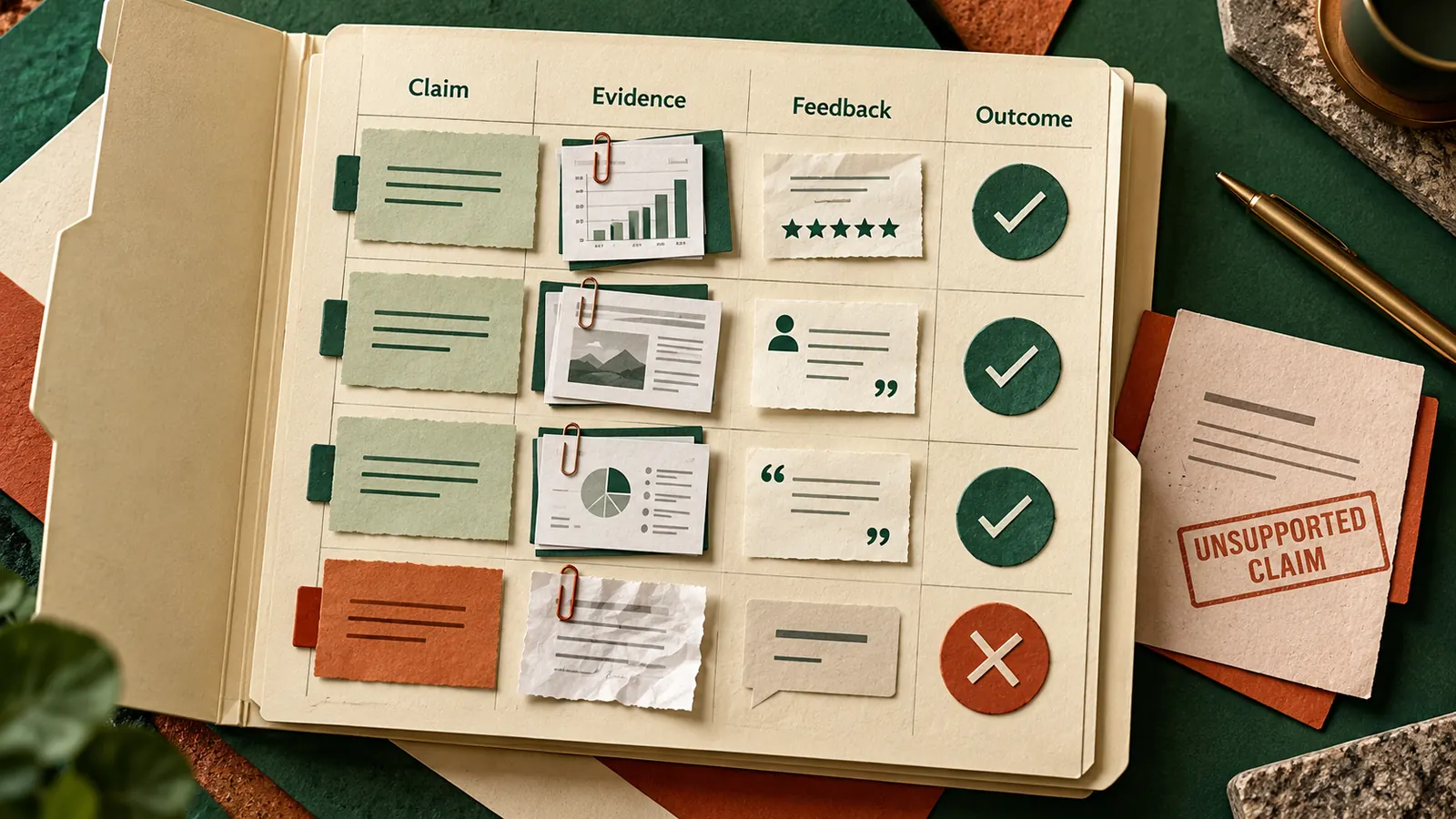
Before asking it to write anything, make a small evidence grid. That gives you a clear record of what you actually did, what changed and what still needs confirmation. You can use it for an annual review, a midyear check-in or a career conversation.
A strong self-review is not the longest task list. It is a short set of contributions you can explain and support.
Start with evidence instead of polished wording
UC Davis Human Resources recommends reviewing completed projects, problems solved, feedback received and the impact of your contribution. Its accomplishment framework uses an action, project and result structure, with numbers where available. That is a useful starting point for AI-assisted writing too.
The five-column evidence grid
- Work Name the project or problem.
- Your role State exactly what you did, separately from the team.
- Outcome Record what changed for a customer, colleague or process.
- Proof Note an approved report, project update or written feedback you can verify.
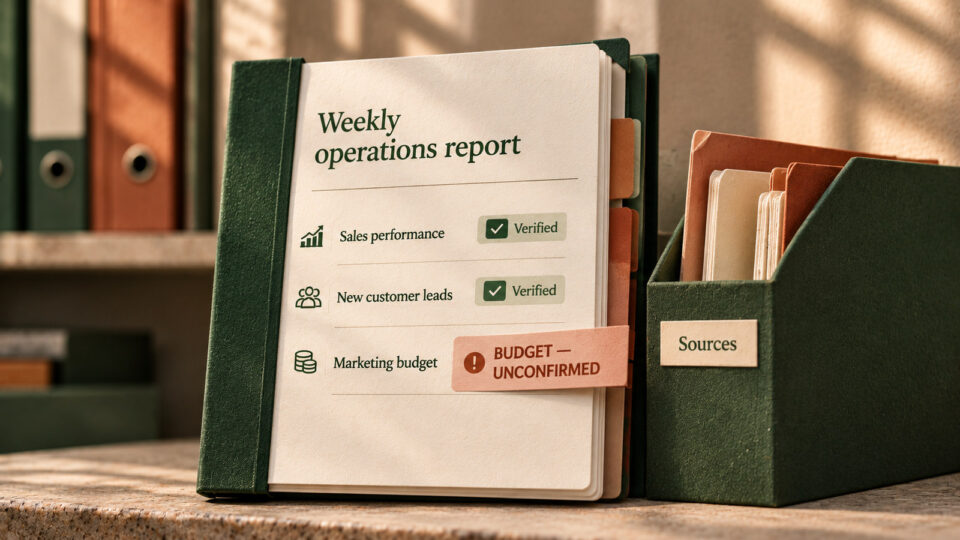
- Confidence Mark the claim verified, approximate or still unconfirmed.
Keep sensitive evidence in your employer-approved system. Only share information your organisation permits with an AI assistant.
See how an ordinary accomplishment changes
Imagine a customer-support coordinator who helped revise a response guide. Their rough note says, “Worked on the support process and made replies faster.” AI might turn this into “Led a transformation that reduced response time by 40 percent.” Neither the leadership claim nor the percentage is supported.
A better entry says, “Rewrote the first-response guide with two teammates and tested it on 15 common enquiries. The team adopted the guide in August. Its effect on response time has not yet been measured.” This still shows useful work without inventing an outcome.
A marketing coordinator who delivered four campaign reports on schedule can similarly describe the decisions those reports supported. If no conversion uplift was measured, they should not invent one. Not every contribution needs a percentage.
Give AI a narrow drafting job
OpenAI warns that ChatGPT can present incorrect facts confidently and recommends checking important information against reliable sources. For a performance review, that means checking every claim about ownership, numbers, dates and results against your own records.
Try this now with a copy-paste prompt
Help me draft an honest employee self-review using only the evidence entries below. Write one concise accomplishment statement per entry. Distinguish my contribution from the team effort. Use action, project and result when the evidence supports it.
Do not invent percentages, revenue, awards, dates, leadership claims or customer outcomes. If an outcome is unknown, state what I completed and mark the outcome as not yet measured. Do not convert approximate figures into exact claims.
After drafting, provide a verification list matching each factual claim to its supporting entry. Mark any statement that needs confirmation. Include one balanced challenge and one realistic development goal.
[Paste three to five approved evidence-grid entries with confidential details removed]
Verify Compare every number, date, result and claim of ownership against the original records. Remove anything you cannot explain to your manager.
Check the claims before submitting
A five-minute final check
- Ownership Did you lead, support or collaborate? Use the accurate verb.
- Numbers Match every count, percentage and saving to a real source.
- Outcome Separate what you delivered from what changed. Say when impact is unmeasured.
- Balance Include a genuine challenge and specific next step.
- Privacy Remove personal and commercially sensitive details that do not belong in the review.
Make the next review easier
At the end of each month, spend five minutes adding one or two entries to the grid. Keep a note of the project, your part, the result and where the proof lives. When the next review arrives, you will have material you can use without relying on memory or letting AI guess.
The outcome to aim for today is three accurate accomplishments with evidence, a concise draft and a short list of facts to confirm. A defensible review is more useful than an impressive-sounding one.
Sources
UC Davis Human Resources – writing a self-evaluation and goals
UC Davis Human Resources – accomplishment statements framework
OpenAI Help Center – verifying important AI-generated claims