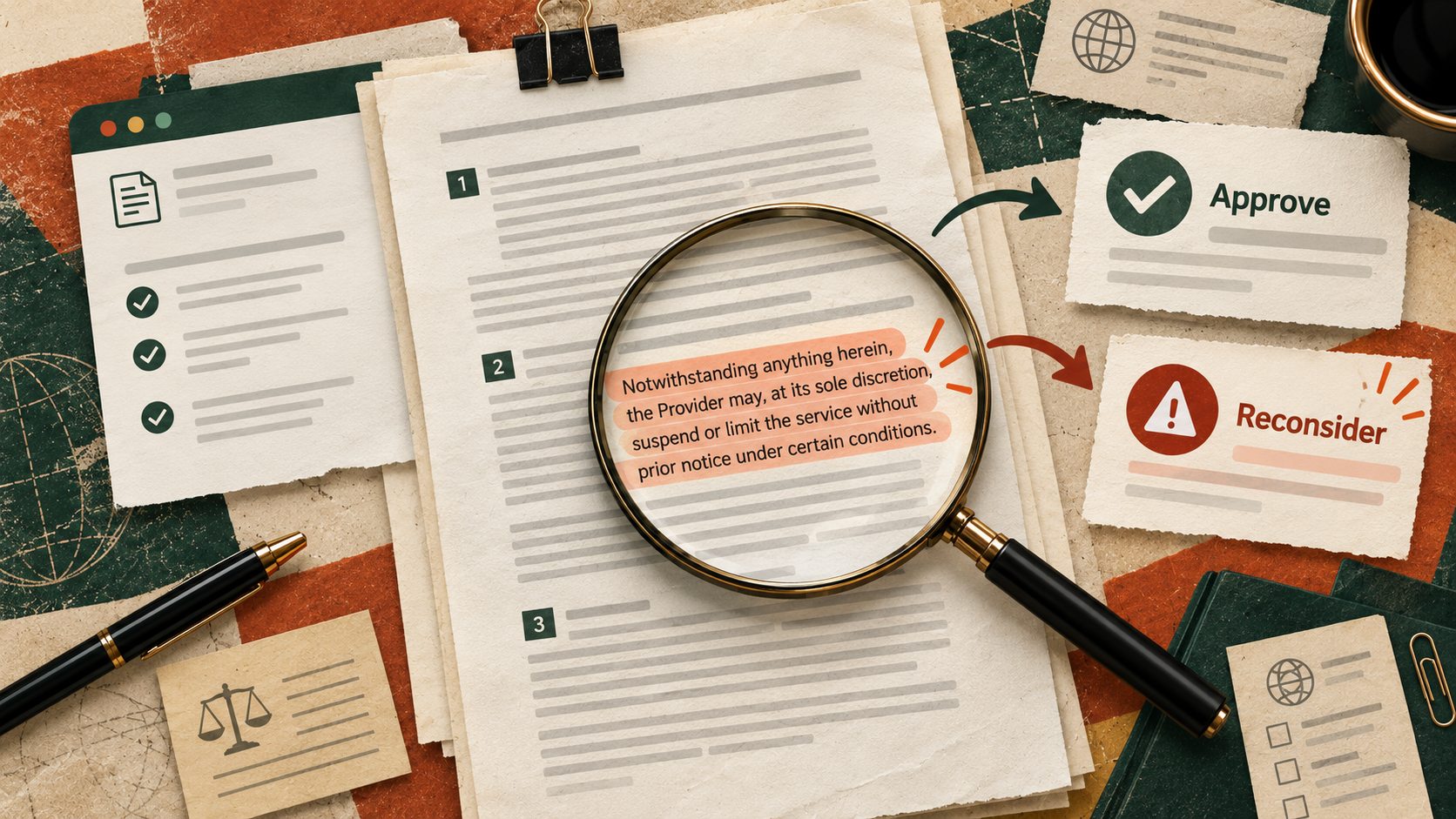
An 18-page supplier proposal lands in your inbox. You ask AI to summarise it. The answer is clear and the price looks reasonable. Then someone spots a small sentence on page 11. The quoted price covers only three locations. Your team needs five.
That is the kind of detail a summary can lose. The danger is not an obviously wrong answer. It is a believable one that overlooks the exception changing the decision.
Research published in 2024 found that some language models struggled to use information buried in the middle of long inputs. A separate EMNLP 2025 study found that long inputs could reduce performance even when relevant information was retrieved. These findings do not mean every current tool will miss your document. They do mean that a fluent summary is not enough evidence for an important decision.
Look for exceptions before you ask for a summary
Start with what could change your answer. Ask the AI to find exclusions, limits, deadlines, conditions, dependencies and conflicting figures. Require the source page or section for each finding. Then check those passages in the original and only afterwards ask for a short decision brief.
The most important sentence may be the one that makes the headline less attractive.
See how a small exception changes a real decision
Imagine a fictional vendor quote of ₹90,000 per month. The cover page says onboarding is included. The scope section adds a condition. The price covers three locations and each additional location costs ₹12,000 per month.
For five locations, the recurring cost becomes ₹114,000, not ₹90,000. That is ₹24,000 extra each month or ₹288,000 over a year. A summary can report the headline price accurately and still lead to the wrong budget.
The same risk appears in hiring policies with exceptions for temporary workers, project briefs with approval conditions and research reports that exclude a customer segment from the headline result.
The three-pass evidence check
Read the document in this order
- Find exceptions Ask for limits, exclusions, dates, dependencies and contradictions relevant to your decision.
- Verify the evidence Open each source page and read the nearby sentences. Check whether the cited text really supports the claim.
- Write the brief Separate verified facts, assumptions and unanswered questions. Include the exceptions before the recommendation.
For a very long document, review it section by section and combine the findings into one evidence table. This is a practical risk-reduction method, not a guarantee that nothing will be missed.
Try this now with a non-sensitive document
Use a public brochure, a fictional proposal or a document you are authorised to upload. Keep confidential files inside approved tools and follow your organisation’s data-handling rules.
Copy-paste prompt for finding the missing condition
Review this document as a careful decision-support analyst. My decision is [describe the decision].
Do not summarise yet. Identify every relevant exception, limit, exclusion, deadline, dependency, qualification, contradictory figure and unanswered question. For each item, provide the exact page or section, a short supporting quotation, why it matters and what I should check in the original.
Mark anything you cannot locate as not verified. Do not invent quotations or page numbers. Then write a brief that separates confirmed facts from assumptions. If the document is too long, tell me which sections require separate review.
Verify before acting Check each high-impact passage in the original, recalculate figures and confirm that the document version is current.
Know what a useful answer looks like
Ask for a table with the condition, source location, decision impact and open question. In the fictional example, the critical row should show the three-location limit and flag the extra ₹24,000 per month for manual verification.
A page reference is a route back to the evidence, not proof by itself. If the tool offers a confident recommendation without traceable passages, treat it as a first pass.
The one-minute sign-off
- Is this the correct document and version?
- Did you check the sections covering price, scope, deadlines and exclusions?
- Can you trace each important conclusion to a source passage?
- Have you checked calculations separately from the AI explanation?
- Could one overlooked condition change the decision or require approval?
For legal, financial or other high-impact decisions, retain the normal specialist review process. The habit worth building is to make AI show the evidence that could change the answer before it makes the answer sound complete.
Sources
ACL Anthology – Lost in the Middle research – 2024
ACL Anthology – Long-context performance research – 2025