Two suppliers send quotes for the same job. One looks cheaper. You copy both into an AI assistant, ask which offer is better and receive a confident recommendation in seconds. The catch is that the lower quote may not include packaging, delivery, setup, revisions or the work you actually need.
A free AI prompt can help you compare the offers without pretending that missing details are zero. The useful result is not an automatic winner. It is a side-by-side comparison, a list of uncertainties and a short message asking suppliers to clarify the gaps.
Why the lowest number is not always the lowest cost
Government procurement guidance offers a practical principle that also helps with ordinary workplace purchases. Compare offers against the same requirements and include relevant charges, rather than treating the headline price as the full answer. The Victorian Government’s value-for-money guide also considers quality, timing, risk and costs beyond the initial price. You do not need to run a formal tender to borrow that common-sense discipline for a small office purchase.
A missing fee is a question to resolve, not a saving you can claim.
This matters for design projects, printed materials, software subscriptions, event suppliers, couriers and freelance services. Two prices can be accurate while the scope behind them is different. AI can organize the comparison, but only the supplier can confirm what is included.
A realistic example with two welcome-kit quotes
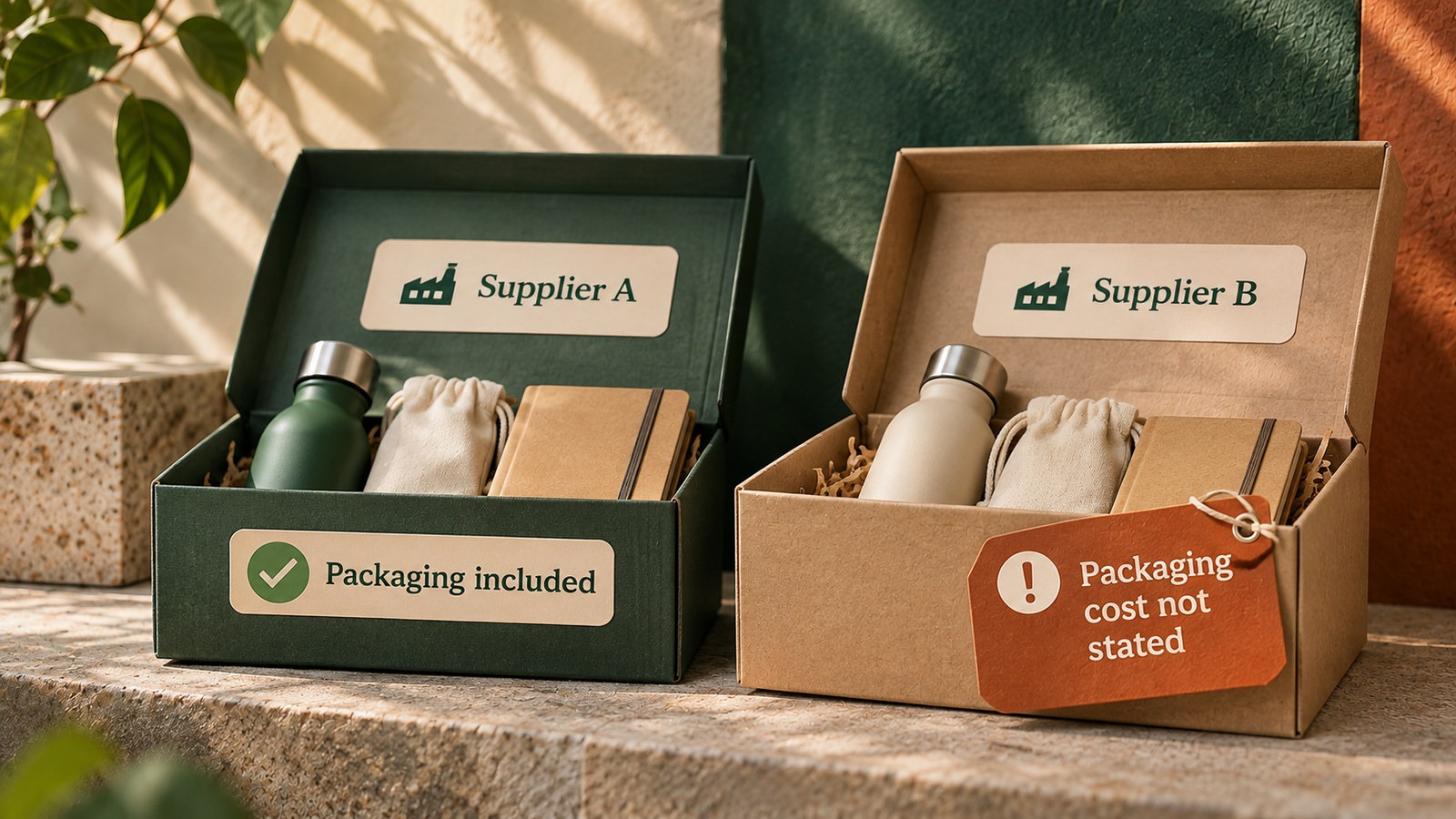
Imagine a marketing coordinator ordering 200 welcome kits for a new employee programme. Both suppliers offer printing and delivery. Supplier A includes packaging. Supplier B does not mention it. The figures below are fictional and use an illustrative 18 percent tax applied to the stated pre-tax charges. Actual tax treatment depends on the purchase and jurisdiction.
Compare the same 200-kit order
| Item | Supplier A | Supplier B |
|---|---|---|
| Base price | ₹26,000 | ₹27,500 |
| Setup | ₹2,000 | ₹0 |
| Delivery | ₹2,000 | ₹1,000 |
| Illustrative tax | ₹5,400 | ₹5,130 |
| Known total | ₹35,400 | ₹33,630 |
| Packaging | Included | Not stated |
Supplier B has the lower known total by ₹1,770, but it is not yet the verified cheaper complete offer. Packaging could change the comparison. Ask what it costs and whether the 200-kit scope, materials and deadline are equivalent before deciding.
Prepare the quotes before using AI
Use the original written quotes, not a colleague’s summary. Check the quantity, specification, currency, quote date, validity period, delivery location, payment terms, revision allowance and any exclusions. If a quote refers to a separate scope document, read that too.
Remove personal contact details, banking information and confidential prices unless your organisation permits them in the AI tool you are using. For sensitive commercial information, use an approved enterprise system or a fictional version for practice. If you cannot share the original files, copy only the permitted line items into the prompt.
Give each source a simple name such as Quote A and Quote B. Tell the assistant to quote the exact source wording when it flags an inclusion or exclusion. This makes it easier to spot an invented line item or a cost assigned to the wrong supplier.
Copy this free prompt and replace the bracketed text
The supplier quote comparison prompt
I am comparing two supplier quotes for the same purchase. My required quantity, specification, delivery location and deadline are [describe the exact requirements]. Here are the permitted details from Quote A and Quote B.
[Paste Quote A]
[Paste Quote B]
Make a side-by-side table with base price, quantity, setup, shipping or delivery, tax, optional extras, included services, excluded services, payment terms, lead time, quote validity and known total. Keep currencies and tax assumptions explicit.
For every value, say whether it is stated in the quote, calculated from stated figures or not stated. Do not treat an absent fee as zero. Do not invent a tax rate, price, deadline, inclusion or supplier commitment. If quotes cover different quantities or specifications, explain why a direct comparison is not valid.
Show the arithmetic for each known total. Identify the three uncertainties most likely to change the decision. Draft a short, neutral clarification email for each supplier. Do not select a winner until missing costs and scope differences are resolved.
The same prompt works in a free general-purpose AI chat that accepts your permitted text. You do not need a paid plugin or automated purchasing system. The outcome still needs human review, especially when money, contracts or approvals are involved.
Verify the result in six practical checks
Before sending a recommendation
- Recalculate the totals. Use a calculator or spreadsheet. In the example, Supplier A is ₹30,000 before illustrative tax and Supplier B is ₹28,500 before illustrative tax.
- Find each number in its source. Check that no price moved between suppliers and that the currency matches.
- Mark missing details visibly. Packaging is not stated for Supplier B. It is not free by default.
- Compare the actual scope. Check the materials, number of units, revisions, delivery date and acceptance criteria.
- Ask for written clarification. Request a revised total or a clear statement of what is included.
- Use your approval process. Procurement, finance or a manager may need to review the final choice. Keep both quotes and the clarifications with the decision.
Send the supplier one useful question
For Supplier B, a short email could say, “Thanks for the quote for 200 welcome kits. Can you confirm whether individual packaging is included? If not, please share the total additional charge, applicable tax and whether the delivery date remains unchanged.”
That one answer may be more useful than a long AI-generated purchasing report. Once the supplier replies, update the comparison and rerun the arithmetic. If the final price still favours Supplier B and the quality and timing are suitable, you have a defensible recommendation. If the added charge reverses the ranking, you have caught the difference before approval.
Use AI for the comparison, not the commitment
AI is good at extracting fields, spotting missing information and drafting follow-up questions when given clear instructions. OpenAI’s prompt guidance recommends specific context and iterative refinement. Those practices help, but they do not replace checking the original documents or asking suppliers what they actually promise.
Try this with two low-risk fictional quotes first. Time how long it takes to build the comparison, then check whether the assistant finds the missing charges. For a real purchase, the measure of success is a clearer decision record with fewer surprises, not simply a faster answer.
Sources
Acquisition.gov. Evaluation of quotations or offers
Victorian Government. Value for money guide for goods and services
OpenAI Help Center. Prompt engineering best practices for ChatGPT