If an interviewer asks whether you can use AI at work, naming five chatbots is the weakest part of your answer. A stronger response explains one real problem, the instructions you gave, the result you checked and the decision you still made yourself.
That distinction is becoming more relevant. On October 23, NDTV reported interviews with Indian business leaders who said they want practical problem-solving, verification and responsible use, not just tool familiarity. Earlier LinkedIn research found that 66% of recruiters surveyed globally planned to increase AI use in pre-screening interviews in 2026. That figure describes intentions, not proof that every interview now uses AI.
Here is a way to prepare a credible answer in twenty minutes, even if you have never held an AI-focused job.
Show the work behind the polished answer. The correction you made often says more than the tool you used.
Choose one ordinary task with a visible before and after
Pick a task you understand well enough to explain without AI. It might be organizing survey comments, turning a messy meeting transcript into action items, comparing three suppliers or improving a customer FAQ. Avoid choosing a project merely because it involved an advanced model.
For example, imagine a customer-support coordinator reviewing thirty fictional feedback comments. Before using AI, the comments are scattered across a document and repeated complaints are hard to count. The coordinator asks an approved assistant to group them into themes, then checks each theme against the original comments. They find that the assistant has grouped delivery delays and delivery damage together. They separate those issues, recount the examples and build a clearer weekly report.
That is a better interview story than saying the assistant summarized customer feedback. It identifies the human judgement that made the output usable.
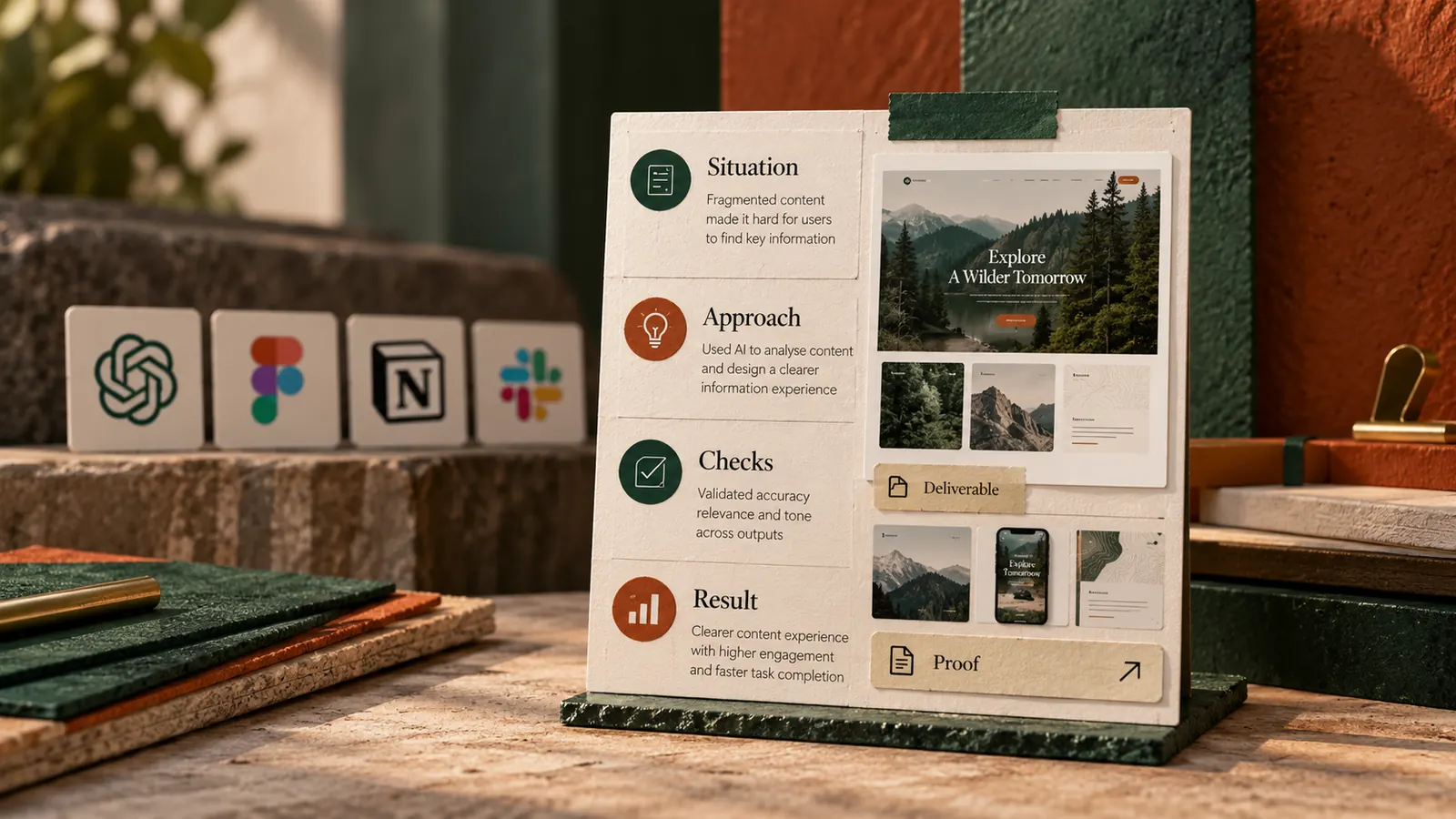
The four-part evidence card
- Problem State what was slow, unclear or error-prone before AI entered the task.
- AI contribution Explain the specific instruction, input type and draft output. Name the tool only if it matters.
- Human check Show one mistake, limitation or decision you verified independently.
- Outcome Describe what improved. Use a real measure if you have one, or clearly label a practice exercise.
Keep a redacted example or simple before-and-after artifact available only when sharing it is permitted.
Turn the evidence card into a natural interview answer
A candidate for an operations role could say that they used AI to create a first pass at grouping recurring customer issues. They supplied a consistent category list, reviewed the original comments and corrected a category that mixed two different problems. The final report was easier to discuss with the team. If they timed the process, they can give the actual minutes saved. If they did not, they should not invent a percentage.
A marketing candidate might instead describe using AI to compare public competitor messages, checking each claim against the actual website and removing outdated offers. A finance candidate could explain how they used AI to draft a spreadsheet formula, tested it on a known sample and corrected a missing exception. The transferable skill is controlled use of AI, not memorizing product names.
Try this now with a safe practice example
Open an AI assistant approved for your use. Choose one non-sensitive task you have done, or create a fictional sample if your real work is confidential. Write down what you actually did before asking AI to help. Do not upload client files, personal data, internal results or confidential employer information.
Copy-paste interview preparation prompt
Help me prepare a truthful two-minute interview answer about using AI in everyday work. I will describe one real task or a clearly labeled practice exercise.
Ask me for the original problem, the exact part AI helped with, the inputs I was permitted to use, the independent checks I performed and the result I can honestly support.
Do not invent numbers, employers, tools, outcomes or decisions. If evidence is missing, mark it as not measured. Keep the language conversational rather than rehearsed.
Write a concise answer using four parts – problem, AI contribution, human verification and outcome. Then ask three realistic follow-up questions about errors, privacy and what I would do without AI.
Finally, tell me which sentence sounds too vague or exaggerated and what proof would make it stronger.
Test the answer before you use it
Read the answer aloud and remove any sentence you cannot defend. Ask a friend to interrupt with a simple question about the source data or the mistake you caught. If you cannot explain the correction, your story is not ready.
Five checks before the interview
- Can you explain the task without naming the AI tool?
- Can you show what you asked AI to produce and why?
- Can you name at least one specific check you personally performed?
- Are every number, claim and project detail true and shareable?
- Can you explain what you would do if the tool produced a confident but wrong answer?
If your example is a practice exercise, say so plainly. Demonstrating a sound method is useful without presenting it as paid client work.
Why proof matters more than polished language
LinkedIn reported in January that recruiters were having greater difficulty identifying qualified candidates. In India, Business Standard reported in February that 53% of recruiters who found hiring harder cited a rise in AI-generated applications. Those findings are survey results and should not be treated as a universal hiring rule. They do explain why a generic AI-polished answer may be less persuasive than a specific, verifiable story.
You do not need to promise that AI transformed a business. You need to show that you can choose a suitable task, give useful instructions, protect information, catch mistakes and take responsibility for the final work. Prepare one such example today and you will have something more substantial than another tool name on your CV.
Sources
NDTV – What employers expect from AI skills in interviews, October 23, 2026
LinkedIn – Research on job seekers and recruiters in 2026, January 7, 2026
Business Standard – Indian recruiters and AI-generated applications, February 3, 2026