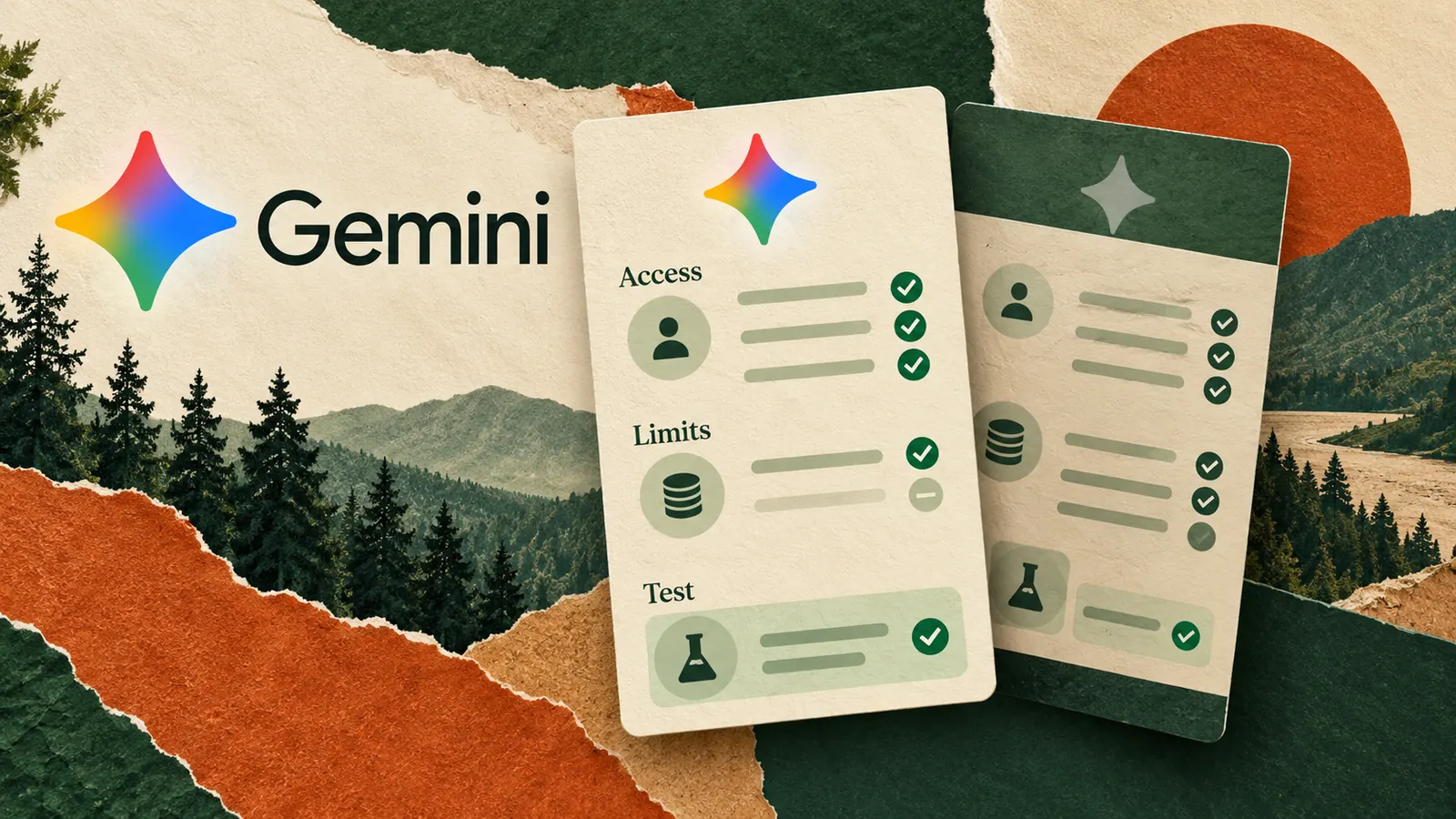
Paying for an AI assistant does not always mean you can keep using the same model. If Gemini is part of your everyday writing, research or planning routine, a change to its model selector is a reason to check what you actually need before paying for a higher tier.
Google’s updated Gemini help page says model availability for personal accounts is changing from October 2026. Free users moved to an automatic model selection system from October 9, while Google AI Plus subscribers are being notified by email of their own effective date. Reports published on October 15 cite subscriber emails naming November 13 for loss of selectable Pro models in the Gemini app and Search AI Mode. That reported date should not be assumed to apply to every account or country.
Google’s current US plan comparison lists Flash access for AI Plus and more advanced Gemini 4 Argon access for AI Pro and Ultra. Features, pricing and eligibility can vary by region. This is a subscription decision, not evidence that every task needs the most expensive model.
Do not upgrade for a model name. Upgrade only when a real task performs better after checking the result.
First find out what will change for your account
Open Gemini while signed in to the personal account you actually use. Check the model picker, the plan name and any Google One email about model access. Save the effective date shown in your notice. If your employer provides Gemini through a Workspace licence, ask your administrator about that licence instead of assuming consumer plan rules apply.
A four-part subscription check
- Confirm your plan Write down whether you use free Gemini, Google AI Plus, AI Pro or AI Ultra.
- Check your model picker Record which models you can select today and whether automatic selection is enabled.
- Check your notice Look for Google’s account-specific email and verify the date in your own account.
- List your real work Identify two ordinary tasks and one demanding task you use Gemini for each week.
Run the same work through the models you can use
Consider a marketing coordinator who uses Gemini for three jobs. They shorten long meeting notes, draft a polite customer follow-up and compare two campaign proposals. The first two jobs may be satisfactory with a faster model. The proposal comparison might benefit from more reasoning, but the only useful test is whether the model identifies trade-offs correctly against the source material.
Do not upload confidential client files to a personal account just to run this test. Use fictional details or materials your organisation explicitly permits. For the proposal comparison, use two short sample options with a budget, delivery date, expected outcome and one known risk each.
Try this now with one reusable test prompt
Compare the two fictional campaign options below for a small business that needs qualified leads within six weeks.
Use only the facts supplied. Make a short table covering cost, timing, expected benefit, main risk and information still missing. Recommend which option to test first and explain the trade-off in plain language.
If the evidence is insufficient, say what needs confirmation. Do not invent conversion rates, performance results or guarantees.
Option A – [paste a short fictional plan with budget, timeline and risks].
Option B – [paste a different fictional plan with budget, timeline and risks].
Verify Check every number against the two inputs. Confirm that the recommendation reflects your stated six-week goal and that unknowns are not presented as facts.
Use a simple score before spending more
Run the same sample on the models currently available to you. Keep the prompt and inputs identical. Note how long each result takes, whether the important details are correct, whether the model invents evidence and how much manual correction is required. A polished paragraph is not a pass if it changes the budget or misses a deadline.
Decide with three practical outcomes
- Stay on your current plan If your everyday outputs are accurate after a quick review, you may not need more expensive model access.
- Test an upgrade first If a demanding weekly task repeatedly fails, compare it using an eligible advanced model before committing to a longer subscription.
- Reconsider the tool If your main need is storage, integrations or a feature unavailable in your country, compare the whole plan rather than only the model label.
What to verify before you change plans
Check the current price in your own country, the next billing date, cancellation terms, included storage and any family benefits. Google describes different usage limits for free, Plus, Pro and Ultra plans, and says more demanding features can use allowance faster. A plan with a stronger model can still be poor value if your usage is occasional.
Check the current Google support page and plan comparison again immediately before paying. Product pages can change during rollouts, and a reported subscriber email is not a substitute for the notice in your own account. For work accounts, follow company procurement and data-use policies.
The useful outcome today is a small decision record. Keep your current plan, the tasks you tested, which model handled them adequately, the date your access changes and the reason an upgrade would or would not be worth it. That gives you a decision you can revisit without starting the research again.
Sources
Google Gemini Help – changes to model access and limits, October 2026
Google One – current Google AI plan comparison
Android Authority – reported AI Plus subscriber notices, October 15, 2026